Ukraine’s Minister of Finance took part in the presentation of the OECD Report on Strengthening Financial Markets for Ukraine’s Recovery
-
About Ministry
- Recruitment
-
Accountable agencies
-
State Enterprises and Institutions Belonging to the Sphere of Management of the Ministry
- State enterprise "Management for the operation of the property complex"
- SERVICE AND PUBLISHING CENTR
- Central Treasury sample control enterprise
- Eastern state-owned enterprise of sampling control
- Western state-owned enterprise screening control
- Southern state enterprise of sampling control
- Dnipropetrovsk state-owned enterprise of sampling control
- State enterprise Kyiv offset factory
- State Service for Financial Monitoring
- State Treasury
- The State Audit Service of Ukraine
- State Tax Service of Ukraine
- State Customs Service of Ukraine
- Personnel Audit Procedures of State Customs Service
- State Tax University
-
State Enterprises and Institutions Belonging to the Sphere of Management of the Ministry
- Minfin Panel
-
Policy Issues
- Budget policy
- Tax Policy
-
Customs Policy
-
Integration of customs legislation into EU law
- Direct and indirect customs representation: possible scenarios for declaring goods and the role of a customs broker
- Customs representative and customs holder: who submits and signs documents
- Confirmation of the reliability of credentials for obtaining authorizations
- Authorization to carry out customs brokerage activities
- Integration of customs IT systems to MASP-C
-
Integration of customs legislation into EU law
-
Accounting and Auditing
-
Accounting
-
Introduction of International Financial Reporting Standards
- Translation of International Financial Reporting Standards 2025
- Translation of international financial reporting standards of 2024
- Translation of international financial reporting standards of 2023
- Archive of translations
- Taxonomy
- Translation of technical publications
- General Clarifications (filled in after the preparation of the relevant letters of explanation)
- Accounting in Private Sector
- Accounting in the Public Sector
- Methodological Accounting Council under the Ministry of Finance of Ukraine (download a short description)
- IFRS Council under the Ministry of Finance of Ukraine (download a short description)
-
Introduction of International Financial Reporting Standards
- Auditing
- Sustainability reporting
-
Accounting
-
Debt policy
- Overview
- Debt News
- Debt Statistics
- Domestic Bonds
- Primary Dealers
- Eurobonds
- Credit Rating
- Investor Relations
- DMO Awards
- Anti-money laundering policy (AML)
- Financial Policy
- National revenue strategy
-
International Cooperation
-
Partners
- EU
- International Monetary Fund
-
Cooperation in Attracting Financing from the International Financial Institutions
- Development Bank of the Council of Europe
- Procedure for attracting funds of International Financial Institutions
- World Bank
- EBRD
- EIB
- Deutsche Gesellschaft für Internationale Zusammenarbeit (GIZ) GmbH
- KFW
- Register of Joint IFIs Projects at the Stage of Preparation and Implementation (information)
- International Technical Assistance (within the competence of the Ministry of Finance)
- Monitoring of international technical assistance projects
- Cooperation with the Development Partners
- Ukraine Donor Platform
-
Partners
- International Tax Relations
- Development of Public Internal Financial Control (PIFC)
-
Public investment management
- Regulatory documents
- Implementation of the roadmap for reforming the management of public investments
- Interdepartmental Commission on the Distribution of Public Investments
- Unified portfolio of public investment projects (list of priority public investment projects)
- Interdepartmental working group on reforming the public investment management system
- Reference information
-
Other Areas of Public Policy
- Internal Audit
- Audit Committee of the Ministry of Finance of Ukraine
- Scientific and scientific and technical activity
- Reform Support Team at the Ministry of Finance of Ukraine
- Verification of State Social Payments
-
Fiscal Risks Managament
- Clarifications
- Legislation on Fiscal Risks Management
- List of Economic Entities with which Major Fiscal Risks May Be Related
- Reports
- List of business entities to which the Ministry of Finance approves proposals for individual financial indicators for the planning period, as well as proposals for maximum thresholds for the volume of capital investments
- Operations with precious stones and metals
- Licensing
- Public Finance Management Strategy (PFMS)
- Strategic Plan
-
Key Spending Unit - Ministry of Finance
- Budget Requests
- Passports of Budget Programs
- Evaluation of the Effectiveness of Budget Programs
- Procurement Reports
- Reports on the implementation of public investment projects
- Budget Information
- Information on the effectiveness of the use of public funds
- The structure and volume of budget funds under budget programs
- Cash Management
- Programs
-
Legislation
-
Regulatory Activity
- Regulatory Performance Tracking Reports 2026
- Activity plan of the Ministry of Finance of Ukraine for the preparation of draft regulatory acts in 2026.
- Schedule of measures in 2026 to track the effectiveness of regulatory acts of the Ministry of Finance of Ukraine
- Reports on tracking the effectiveness of regulatory acts in 2025.
- Activity plan of the Ministry of Finance of Ukraine for project preparation regulatory acts in 2025
- Plan-schedule of implementation of measures in 2025 regarding performance tracking regulatory acts of the Ministry of Finance of Ukraine
- reports_on_the_effectiveness_of_regulatory_acts_2024
- The activity plan for the preparation of the regulatory acts draft 2024
- Schedule of measures to monitor the effectiveness of regulatory acts 2024
- reports_on_the_effectiveness_of_regulatory_acts_2023
- The activity plan for the preparation of the regulatory acts draft 2022
- Schedule of measures to monitor the effectiveness of regulatory acts 2023
- Reports on the effectiveness of regulatory acts 2022
- The activity plan for the preparation of the regulatory acts draft 2022
- Schedule of measures to monitor the effectiveness of regulatory acts 2022
- Reports on the effectiveness of regulatory acts 2020
- The activity plan for the preparation of the regulatory acts draft 2021
- Schedule of measures to monitor the effectiveness of regulatory acts 2021
- Reports on the effectiveness of regulatory acts 2020
- The activity plan for the preparation of the regulatory acts draft 2020
- Schedule of measures to monitor the effectiveness of regulatory acts 2020
- Reports on the effectiveness of regulatory acts 2019
- The activity plan for the preparation of the regulatory acts draft 2019
- Schedule of measures to monitor the effectiveness of regulatory acts 2019
- Reports on the effectiveness of regulatory acts 2018
- The activity plan for the preparation of the regulatory acts draft 2018
- Schedule of measures to monitor the effectiveness of regulatory acts 2018
- Reports on the effectiveness of regulatory acts 2017
- The activity plan for the preparation of the regulatory acts draft 2017
- Schedule of measures to monitor the effectiveness of regulatory acts 2017
- Reports on the effectiveness of regulatory acts 2016
- The activity plan for the preparation of the regulatory acts draft 2016
- Schedule of measures to monitor the effectiveness of regulatory acts 2016
- Reports on the effectiveness of regulatory acts 2015
- The activity plan for the preparation of the regulatory acts draft 2015
-
Draft Regulatory Acts Discussion
- Draft regulatory acts for discussion in 2026
- Draft regulatory acts for discussion in 2025.
- Regulatory acts draft for discussion 2024
- Regulatory acts draft for discussion 2023
- Regulatory acts draft for discussion 2022
- Regulatory acts draft for discussion 2021
- Regulatory acts draft for discussion 2020
- Regulatory acts draft for discussion 2019
- Regulatory acts draft for discussion 2018
- Regulatory acts draft for discussion 2017
- Regulatory acts draft for discussion 2016
- Regulatory acts draft for discussion 2015
-
Draft Legislation
- Draft regulatory legal acts in 2026
- Draft normative legal acts in 2025.
- Legal acts drafts 2024
- Legal acts drafts 2023
- Legal acts drafts 2022
- Legal acts drafts 2021
- Legal acts drafts 2020
- Legal acts drafts 2019
- Legal acts drafts 2018
- Legal acts drafts 2017
- Legal acts drafts 2016
- Legal acts drafts 2015
-
Regulatory Activity
-
Data
- Cooperation with Civil Society
- Press Center
.jpeg)
.jpeg)
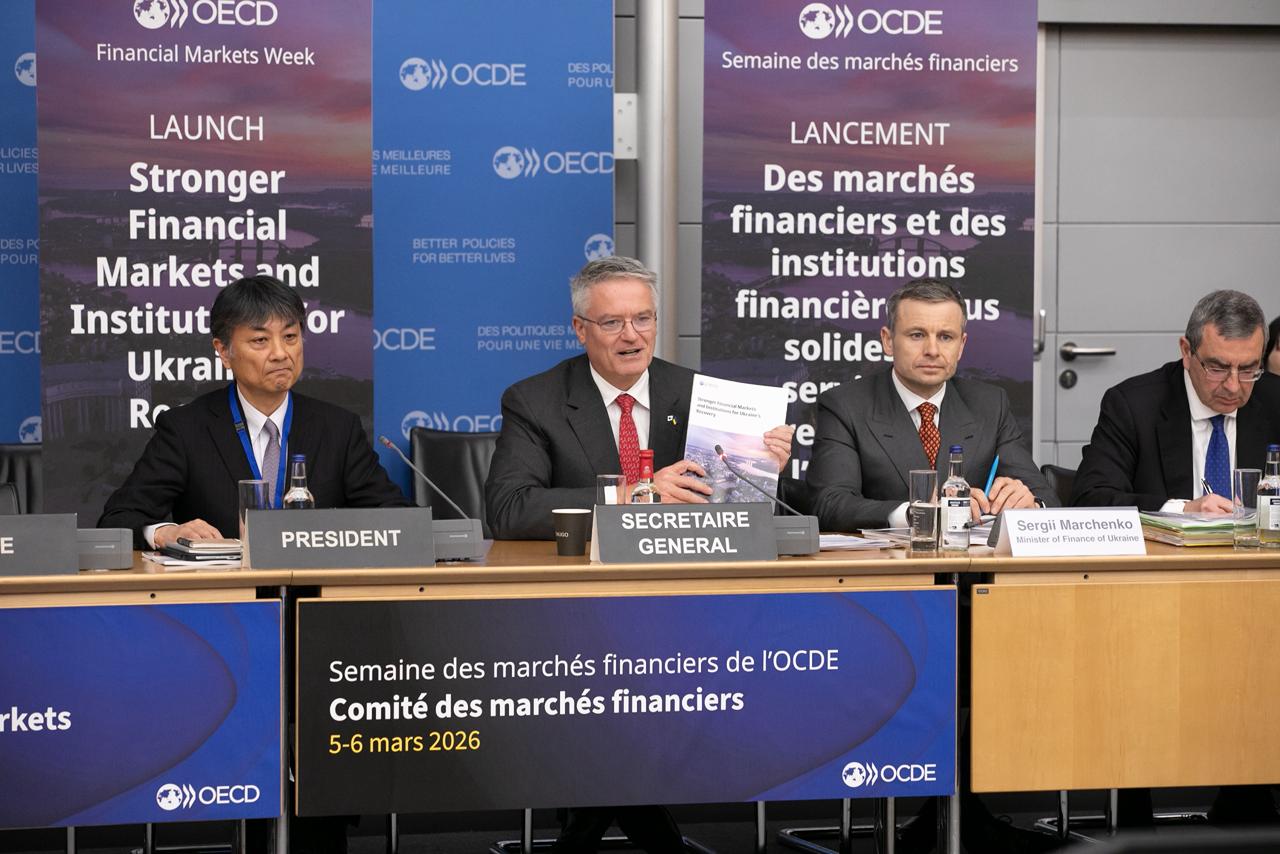
On March 5, 2026, the Minister of Finance of Ukraine Sergii Marchenko participated in the presentation of the Organisation for Economic Co-operation and Development (OECD) report “Stronger Financial Markets and Institutions for Ukraine’s Recovery”, held at the OECD headquarters in Paris.
The event was also attended by Governor of the National Bank of Ukraine Andriy Pyshnyy, OECD Secretary-General Mathias Cormann, Chair of the OECD Committee on Financial Markets and Assistant Governor of the Bank of Japan Seiichi Shimizu, and OECD Director for Financial and Enterprise Affairs Carmine Di Noia.
The OECD report provides recommendations on strengthening financial markets, corporate governance, public debt management, consumer protection in financial services, and the development of the pension system, all of which are aimed at facilitating effective investment mobilization for Ukraine’s recovery.
During his remarks, Sergii Marchenko emphasized that despite the full-scale war, Ukraine’s financial system remains resilient thanks to prudent government policies and the support of international partners.
“Ukraine continues to manage its public debt responsibly to minimize long-term risks associated with its growth resulting from the increased State Budget deficit and defense expenditures caused by russia’s full-scale invasion. We are working diligently to ensure debt sustainability and create the conditions necessary for the country’s recovery,” the Minister of Finance noted.
On an annual basis, the debt portfolio has become cheaper and longer in maturity, reducing servicing costs and lowering refinancing risks in the medium term. As of January 31, 2026, the weighted average interest rate on public debt decreased to 4.51%, compared to 4.55% in December 2025 and 5.0% in January 2025. At the same time, the weighted average time to maturity reached 13.29 years, compared to 11.6 years in January 2025.
In 2025, the restructuring of GDP warrants was successfully completed. On December 24, 2025, with the support of 99.06% of investors’ votes, GDP warrants were exchanged for new Eurobonds and fully cancelled, improving budget predictability, strengthening debt sustainability, and eliminating potential payments in 2025–2041 estimated at up to USD 20 billion.
Domestic government bonds remain the second-largest source of State Budget financing (after ERA loans backed by future revenues from frozen russian assets). Even during the war, Ukraine continues to implement market development instruments, including switch auctions on the Bloomberg platform, which help increase market liquidity and extend borrowing maturities.
According to the Minister, the OECD recommendations largely align with the strategic objectives of the Medium-Term Public Debt Management Strategy for 2026–2028.
It should be recalled that in 2025 the Medium-Term Public Debt Management Strategy for 2026–2028 was approved. The Strategy sets three key objectives:
1. Increasing the share of grants and other non-debt financing to support state budget funding.
2. Reducing debt risks by lowering borrowing costs, extending maturities, and optimizing the debt structure.
3. Maintaining investor relations and stimulating the development of the domestic government bond market as an instrument for economic recovery.
The implementation of the OECD report’s recommendations will take place gradually, taking into account the security and economic situation, and will become an important element of preparations for Ukraine’s post-war recovery and its economic integration into international markets.