The Government does not support the draft law on amendments to the operation of the VAT-related risk monitoring system which was initiated by the Parliament’s committee for tax and customs policy
-
About Ministry
- Recruitment
-
Accountable agencies
-
State Enterprises and Institutions Belonging to the Sphere of Management of the Ministry
- State enterprise "Management for the operation of the property complex"
- SERVICE AND PUBLISHING CENTR
- Central Treasury sample control enterprise
- Eastern state-owned enterprise of sampling control
- Western state-owned enterprise screening control
- Southern state enterprise of sampling control
- Dnipropetrovsk state-owned enterprise of sampling control
- State enterprise Kyiv offset factory
- State Service for Financial Monitoring
- State Treasury
- The State Audit Service of Ukraine
- State Tax Service of Ukraine
- State Customs Service of Ukraine
- Personnel Audit Procedures of State Customs Service
- State Tax University
-
State Enterprises and Institutions Belonging to the Sphere of Management of the Ministry
- Minfin Panel
-
Policy Issues
-
Budget policy
- Budget
- Transparent Budget
- BudgetPRO Project - Budget Policy
- Tax Policy
-
Customs Policy
-
Integration of customs legislation into EU law
- Direct and indirect customs representation: possible scenarios for declaring goods and the role of a customs broker
- Customs representative and customs holder: who submits and signs documents
- Confirmation of the reliability of credentials for obtaining authorizations
- Authorization to carry out customs brokerage activities
- Integration of customs IT systems to MASP-C
- Draft of the new Customs Code of Ukraine
- Survey for citizens and businesses
-
Integration of customs legislation into EU law
-
Accounting and Auditing
-
Accounting
-
Introduction of International Financial Reporting Standards
- Translation of International Financial Reporting Standards 2026
- Translation of International Financial Reporting Standards 2025
- Translation of international financial reporting standards of 2024
- Translation of international financial reporting standards of 2023
- Archive of translations
- Taxonomy
- Translation of technical publications
- General Clarifications (filled in after the preparation of the relevant letters of explanation)
- Strategy for applying international financial reporting standards
- Accounting in Private Sector
- Accounting in the Public Sector
- Methodological Accounting Council under the Ministry of Finance of Ukraine (download a short description)
- IFRS Council under the Ministry of Finance of Ukraine (download a short description)
-
Introduction of International Financial Reporting Standards
- Auditing
- Sustainability reporting
-
Accounting
-
Debt policy
- Overview
- Debt News
- Debt Statistics
- Domestic Bonds
- Primary Dealers
- Eurobonds
- Credit Rating
- Investor Relations
- DMO Awards
- Anti-money laundering policy (AML)
- Financial Policy
- National revenue strategy
-
International Cooperation
-
Partners
- EU
- International Monetary Fund
-
Cooperation in Attracting Financing from the International Financial Institutions
- Development Bank of the Council of Europe
- Procedure for attracting funds of International Financial Institutions
- World Bank
- EBRD
- EIB
- Deutsche Gesellschaft für Internationale Zusammenarbeit (GIZ) GmbH
- KFW
- Register of Joint IFIs Projects at the Stage of Preparation and Implementation (information)
- International Technical Assistance (within the competence of the Ministry of Finance)
- Monitoring of international technical assistance projects
- Cooperation with the Development Partners
- Ukraine Donor Platform
-
Partners
- International Tax Relations
- Development of Public Internal Financial Control (PIFC)
-
Public investment management
- Regulatory documents
- Implementation of the roadmap for reforming the management of public investments
- Interdepartmental Commission on the Distribution of Public Investments
- Unified portfolio of public investment projects (list of priority public investment projects)
- Interdepartmental working group on reforming the public investment management system
- Reference information
-
Other Areas of Public Policy
- Internal Audit
- Audit Committee of the Ministry of Finance of Ukraine
- Scientific and scientific and technical activity
- Reform Support Team at the Ministry of Finance of Ukraine
- Verification of State Social Payments
-
Fiscal Risks Managament
- Clarifications
- Legislation on Fiscal Risks Management
- List of Economic Entities with which Major Fiscal Risks May Be Related
- Reports
- List of business entities to which the Ministry of Finance approves proposals for individual financial indicators for the planning period, as well as proposals for maximum thresholds for the volume of capital investments
- Operations with precious stones and metals
- Licensing
- Public Finance Management Strategy (PFMS)
- Strategic Plan
-
Key Spending Unit - Ministry of Finance
- Budget Requests
- Passports of Budget Programs
- Evaluation of the Effectiveness of Budget Programs
- Procurement Reports
- Reports on the implementation of public investment projects
- Budget Information
- Information on the effectiveness of the use of public funds
- The structure and volume of budget funds under budget programs
- Cash Management
- Programs
-
Budget policy
-
Legislation
-
Regulatory Activity
- Regulatory Performance Tracking Reports 2026
- Activity plan of the Ministry of Finance of Ukraine for the preparation of draft regulatory acts in 2026.
- Schedule of measures in 2026 to track the effectiveness of regulatory acts of the Ministry of Finance of Ukraine
- Reports on tracking the effectiveness of regulatory acts in 2025.
- Activity plan of the Ministry of Finance of Ukraine for project preparation regulatory acts in 2025
- Plan-schedule of implementation of measures in 2025 regarding performance tracking regulatory acts of the Ministry of Finance of Ukraine
- reports_on_the_effectiveness_of_regulatory_acts_2024
- The activity plan for the preparation of the regulatory acts draft 2024
- Schedule of measures to monitor the effectiveness of regulatory acts 2024
- reports_on_the_effectiveness_of_regulatory_acts_2023
- The activity plan for the preparation of the regulatory acts draft 2022
- Schedule of measures to monitor the effectiveness of regulatory acts 2023
- Reports on the effectiveness of regulatory acts 2022
- The activity plan for the preparation of the regulatory acts draft 2022
- Schedule of measures to monitor the effectiveness of regulatory acts 2022
- Reports on the effectiveness of regulatory acts 2020
- The activity plan for the preparation of the regulatory acts draft 2021
- Schedule of measures to monitor the effectiveness of regulatory acts 2021
- Reports on the effectiveness of regulatory acts 2020
- The activity plan for the preparation of the regulatory acts draft 2020
- Schedule of measures to monitor the effectiveness of regulatory acts 2020
- Reports on the effectiveness of regulatory acts 2019
- The activity plan for the preparation of the regulatory acts draft 2019
- Schedule of measures to monitor the effectiveness of regulatory acts 2019
- Reports on the effectiveness of regulatory acts 2018
- The activity plan for the preparation of the regulatory acts draft 2018
- Schedule of measures to monitor the effectiveness of regulatory acts 2018
- Reports on the effectiveness of regulatory acts 2017
- The activity plan for the preparation of the regulatory acts draft 2017
- Schedule of measures to monitor the effectiveness of regulatory acts 2017
- Reports on the effectiveness of regulatory acts 2016
- The activity plan for the preparation of the regulatory acts draft 2016
- Schedule of measures to monitor the effectiveness of regulatory acts 2016
- Reports on the effectiveness of regulatory acts 2015
- The activity plan for the preparation of the regulatory acts draft 2015
-
Draft Regulatory Acts Discussion
- Draft regulatory acts for discussion in 2026
- Draft regulatory acts for discussion in 2025.
- Regulatory acts draft for discussion 2024
- Regulatory acts draft for discussion 2023
- Regulatory acts draft for discussion 2022
- Regulatory acts draft for discussion 2021
- Regulatory acts draft for discussion 2020
- Regulatory acts draft for discussion 2019
- Regulatory acts draft for discussion 2018
- Regulatory acts draft for discussion 2017
- Regulatory acts draft for discussion 2016
- Regulatory acts draft for discussion 2015
-
Draft Legislation
- Draft regulatory legal acts in 2026
- Draft normative legal acts in 2025.
- Legal acts drafts 2024
- Legal acts drafts 2023
- Legal acts drafts 2022
- Legal acts drafts 2021
- Legal acts drafts 2020
- Legal acts drafts 2019
- Legal acts drafts 2018
- Legal acts drafts 2017
- Legal acts drafts 2016
- Legal acts drafts 2015
-
Regulatory Activity
-
Data
- Cooperation with Civil Society
- Press Center
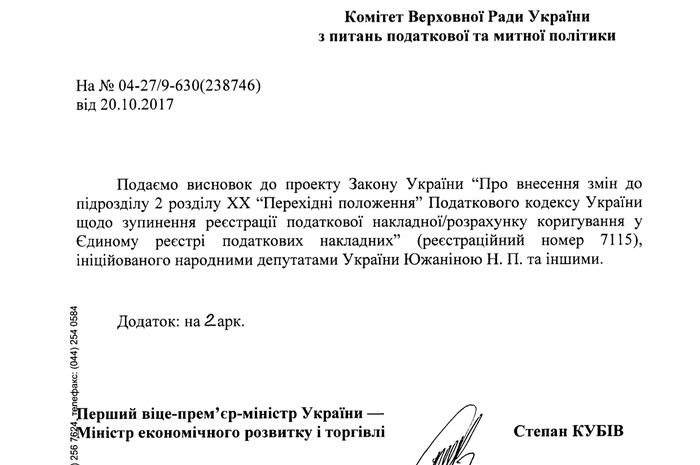
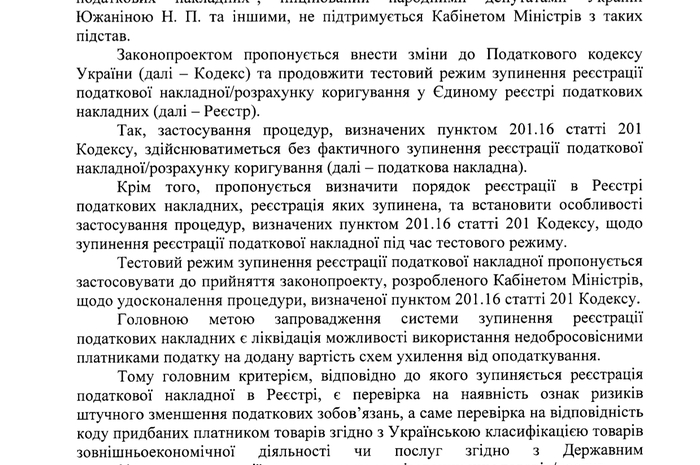
On November 13, the Cabinet of Ministers issued a negative conclusion on the draft law on amendments to the system for the suspension of tax bills registration which had been prepared by the Parliament’s committee for tax and customs policy.
The draft law proposes amendments to the Tax Code and the continued test mode of the system for the suspension of tax bills registration in the Unified Register of Tax Bills. At the same time, it is stated in the conclusion that “the key goal of the system for the suspension of tax bills registration is to liquidate gaps which enables non-diligent VAT-payers to apply tax evasion schemes”. Hence, the termination of the system would result in manipulations and generation of fake VAT.
Currently, the main criteria based on which the registration of tax bills can be suspended is the result of the check for the illicit reduction of tax obligations. Presently, only 0.3% of submitted tax bills are suspended from registration. Also, the Ministry of Finance and the SFS permanently monitor the valid criteria and duly update them, if required.
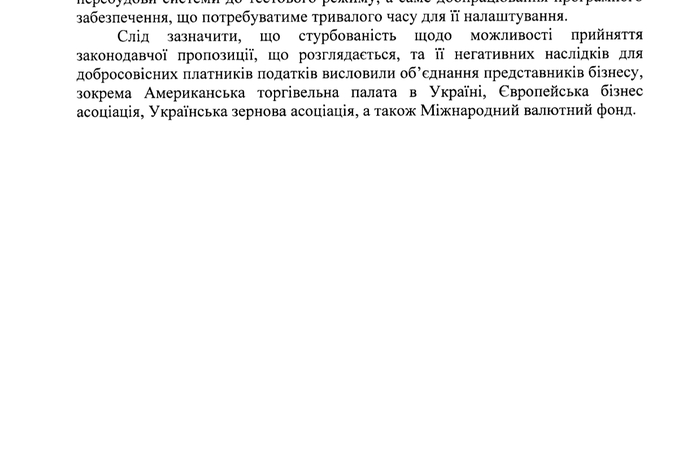
The main research and expert department of the Parliament of Ukraine also provided several critical remarks to the draft law of the Parliament’s committee in its conclusion presented on October 2, 2017.
Also, business associations expressed their concern regarding the possible adoption of the above draft law and its negative impact on diligent taxpayers: US Chamber of Commerce, European Business Association, Ukrainian Grain Association, Coalition for De-shadowing, Association of Ukrainian Entrepreneurs. The International Monetary Fund (IMF) expressed its doubts about the adoption of the draft law too.
Previously, the Ministry of Finance emphasized the risks which the draft law of the Parliament’s committee has for the VAT-related risk monitoring system:
First, a parallel mechanism would be established with high corruption risks, since regional tax authorities would be in position to stop any tax bill “at their own discretion”. The heads of regional tax authorities would be entitled to stop tax bills irrespective if the risk criteria. The same persons would also be authorized to decide about the resumption of the registration procedure. Thus, a mechanism would be established which is exposed to high corruption risks.
Second, taxpayers who are not subject to the risk criteria will probably be exposed to them overnight. The SFS entitled to determine the criteria risks poses a possible hazard in terms of misusing them and violating the principle of keeping the functions of control and policy-making separated between different bodies to avoid conflicts of interests. According to the current procedure, the list of the risk criteria is agreed with the State Regulatory Service and the Ministry of Justice.
Third, it is obvious that the termination of the system for the automated suspension of the registration of potentially fake tax bills would result in direct revenue losses for the state budget. The stop of the system would also lead to lower VAT revenues. So far, the system for risk monitoring has contributed to the significant increase of the VAT revenues. If it’s terminated, illegal money-laundering centres will resume their operations pursuing manipulations with fake VAT claims.
Fourth, the return to the “manual” suspension of tax bills would disrupt the automated VAT refund. Now, each tax bill which has passed the risk monitoring guarantees that the respective transaction is real. If the automated system is terminated, it will be impossible in the mid-term run to refund VAT automatically without additional tax checks. In this case, taxpayers could again be made liable for the illegal actions of third parties.